
Struggling with Time Pressure in the GL 11+ Maths Exam? An Easy Guide to Estimation and Eliminating Wrong Answers
If you’re preparing for the 11+ GL Maths exam, or your child is, you know that questions involving percentages and time can feel a little overwhelming, especially when you’re under serious time pressure. Today, I’m Mohi, and I’ll break down a real question one of my students found tough. We’ll walk through it together, step by step, so you not only learn the maths—but also the little tricks and strategies that make all the difference under exam conditions.
This post will be super detailed and packed with examples, lists, images, quotes, and all the good stuff to help you (and your child) really get a grip on this type of question. Let’s dive in!
Table of Contents
- Understanding the Question
- Breaking Down the Numbers
- Percentage Basics Explained
- Estimation: The Secret Exam Power
- Elimination: Cutting Out the Wrong Choices
- Detailed Step-by-Step Solution
- Why Estimation and Elimination Work
- Extra Tips for GL 11+ Maths Success
- FAQs
- One-to-One Tuition and Group Support
- Conclusion: You’ve Got This!
Understanding the Question
Before we even think about picking up a calculator or jotting down sums, let’s look at what the examiners are really asking us.
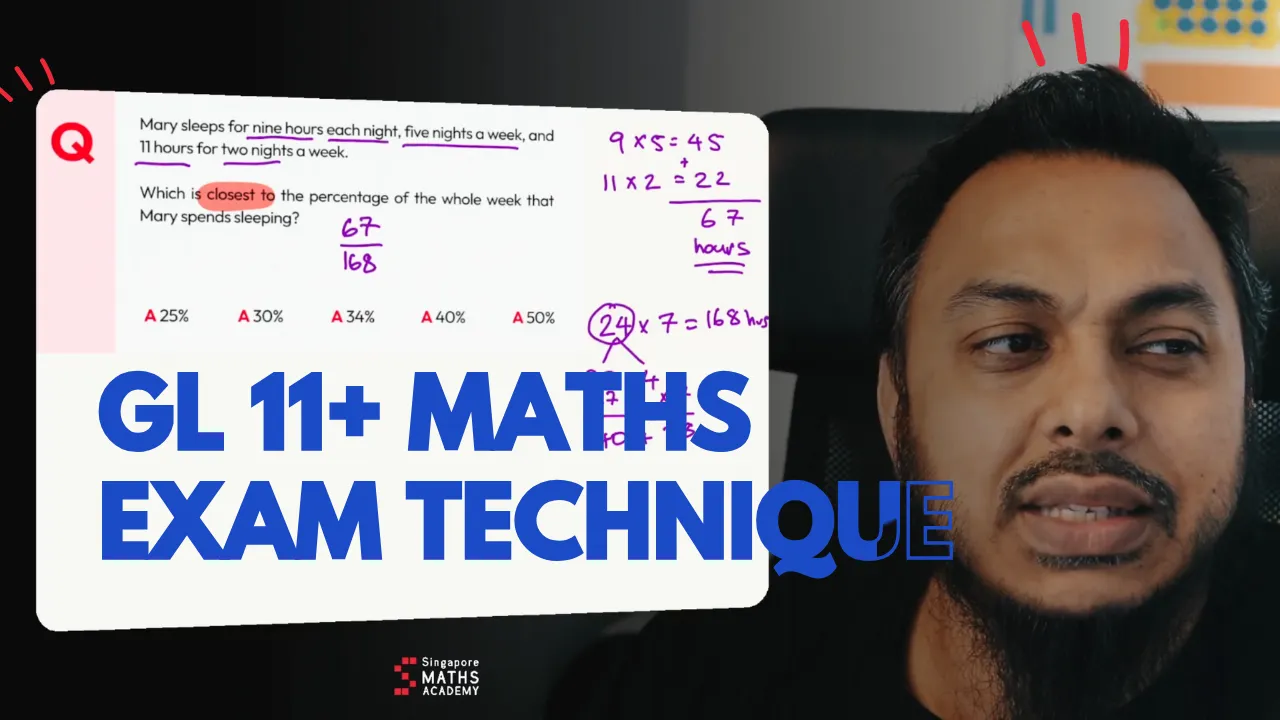
“Mary sleeps nine hours each night, five nights a week and 11 hours for two nights a week. Which is the closest to the percentage of the whole week that Mary spends sleeping?”
You’re given answer options:
- 25%
- 30%
- 34%
- 40%
- 50%
At first glance, these answers are all quite close. The biggest difference is between 40% and 50% (10%), but the rest are only separated by 4% or 5%. That’s a classic sign that the question wants you to be careful and accurate—but also that it’s about the closest answer, so estimation is key.
Let’s highlight what we need:
- Calculate how many hours Mary sleeps in a week.
- Work out how many hours are in a week in total.
- Find the percentage of time spent sleeping out of those total hours.
- See which answer is closest.
Breaking Down the Numbers
Let’s work through the numbers just like we would in the exam. It’s always a good idea to read the question slowly and write down what you know as soon as possible.
Step 1: Calculate Mary’s Total Hours of Sleep
Mary sleeps nine hours each night for five nights, and 11 hours each night for two nights.
Let’s do the sums:
- Five nights: 9 hours per night × 5 nights = 45 hours
- Two nights: 11 hours per night × 2 nights = 22 hours
- Total sleep in a week: 45 hours + 22 hours = 67 hours
So, Mary sleeps 67 hours in a week.
“Mary sleeps 67 hours in a week. That’s the number we need for the next step!”
Step 2: Work Out How Many Hours Are in a Week
There are 24 hours in a day and 7 days in a week.
Let’s multiply:
- 24 hours/day × 7 days = 168 hours in a week
Easy to remember for pretty much any problem with weeks and hours!
Percentage Basics Explained
Now, percentage questions often make students nervous, but the idea isn’t as tough as it seems. Remember, “percentage” just means “out of 100,” so when we talk about what percentage of the week Mary spends sleeping, we’re seeing: out of the 168 hours in a week, how many hours does she spend sleeping, expressed as a percent.
The key formula is:
Percentage of time asleep = (Number of hours asleep ÷ Total hours) × 100For Mary:
Percentage of time asleep = (67 ÷ 168) × 100That’s it! But 168 is a random number, so the maths gets a bit tricky. Here’s where estimation and elimination can save the day.
Estimation: The Secret Exam Power
Sometimes, really accurate maths slows you down and isn’t even necessary to get the right answer. That’s especially true when you’re asked, “Which is closest?” This question doesn’t want an exact answer out to two decimal points; it wants a rounded, nearby value.
Let’s see how our estimation powers can keep things moving fast and confidently.
Estimating the Fraction
- First, note that 67 is the number of sleeping hours, out of 168 total.
- The answers range from 25% to 50%.
- We need to see where 67 out of 168 fits into those percentages.
Adjusting Numbers for Simpler Calculation
What’s tricky: turning 168 into 100. Sometimes, you can simplify the fraction so the denominator gets closer to 100, making the math smoother. Here’s how that could look:
- 67 (hours slept) out of 168 (total hours)
- 68 is quite close to 67, so 68/168 (just to check)
- 68 and 168 are both divisible by 4:
- 68 ÷ 4 = 17
- 168 ÷ 4 = 42
- So, 17/42
But let’s try something even closer. Let’s divide top and bottom by 2:
- 67 ÷ 2 ≈ 33.5 (doesn’t come out even)
- 168 ÷ 2 = 84
So, 33.5/84—not a clean fraction, but we’re getting the idea.
Comparing to 34 out of 84
If we think of it as roughly 34 out of 84:
- If it were 34 out of 100, that would be 34%.
- But 34 out of 84 is more than 34 out of 100—because the denominator is much less than 100.
So we know immediately that the answer must be more than 34%.
“If it was 34 out of 100, that would be 34%. But 34 out of 84 is more than 34%, so we can already begin crossing off answer choices!”
Elimination: Cutting Out the Wrong Choices
Now, let’s take our powerful estimation and use elimination to get rid of answers we know aren’t right.
Step-by-Step Elimination
- Compare with 34%
- 34 out of 84 is higher than 34% (as shown above).
- So both 25% and 30% are too low.
- 34% itself is too low too.
- Can it be 50%?
- 50% would mean half of 84, which is 42.
- We have 34 out of 84, which is far less than 42.
- So 50% is too high.
- Which Numbers Remain?
- By process of elimination, we’re left with 40% as our best estimate.
Why not just calculate it exactly?
112+ questions might be hard, calculators not allowed, and options are close together. The point is to pick the number that is closest based on strong estimation and fast thinking.
“Elimination is a good approach when you have questions like this. It’s about the closest answer, so estimation and approximation really help!”
Detailed Step-by-Step Solution
Let’s walk through the entire method again, but this time, a bit slower and with all the working-out shown clearly.
1. Calculate Total Sleeping Hours
- 9 hours/night × 5 nights = 45 hours
- 11 hours/night × 2 nights = 22 hours
- Total = 45 + 22 = 67 hours
2. Total Hours in a Week
- 24 hours/day × 7 days = 168 hours
3. Set Up the Percentage Equation
[\text{Sleeping percentage} = \left(\frac{67}{168}\right) \times 100]
Let’s try and get a rough idea without a calculator:
- 168/2 = 84
- 67/2 ≈ 33.5
- So, 33.5 out of 84
If we doubled the denominator (from 84 to 100), that would make the fraction smaller, not bigger.
Let’s try and get closer:
- 34/84 is around 40.5%
How? Divide 34 by 84:
[34 \div 84 \approx 0.4048 \Rightarrow 40.48%]
So, our adjusted estimation is right around 40%—and that’s an answer option! Done.
“So instead of working out the specific or very, you know, going down to the hundreds and getting the exact percentage, I’ve narrowed down my answer and I’ve got 40% because I’ve eliminated the other answers.”
Why Estimation and Elimination Work
When examiners design questions where multiple answers are close together, they’re checking if you can:
- Work under time pressure
- Recognise when perfection isn’t the goal—speed and accuracy are more important
- Use smart strategies like estimation and elimination, so you don’t get stuck on tough calculations and run out of time for the rest of the paper
Reasons to Use Estimation and Elimination
- Saves Time: No need to do the full calculation when options are spread out.
- Reduces Mistakes: Working with simpler numbers makes slip-ups less likely.
- Builds Confidence: Letting go of perfection lets you move faster.
“Estimation and elimination: your best friends on exam day!”
Extra Tips for GL 11+ Maths Success
Succeeding in timed exams is about more than just knowing the maths. Here are some exam-smart approaches to boost your score:
1. Always Write Down What You Know
Write out each step, even if you think you can do it in your head. This stops silly mistakes.
2. When Options Are Close, Estimate
If the answers are spaced far apart (e.g. 1%, 10%, 50%, 90%), you need precision. But with answers that are close, estimation wins.
3. Eliminate Without Hesitation
Cross out answers that can’t be right and reduce your choices. Every time you cross one out, your chances get better.
4. Use “Friendly” Numbers
When dividing or multiplying, round the numbers up or down to make life easier—just don’t drift too far from the original value.
5. Don’t Doubt Yourself!
If you’ve logically worked through the steps, trust your maths and move on. Doubting only wastes time.
FAQs
Q: What if my answer isn’t exactly the same as the options listed?
A: That’s by design! The question wants your answer to be closest—not exact. Go for the nearest choice.
Q: Should I show my working in the 11+ exam?
A: Yes, always. Showing your steps can get you marks, even if your final answer is a bit off.
Q: Do I always need to estimate?
A: Only when it makes sense. If you have time and the numbers divide neatly, do the full calculation—but when pressed, use estimation.
Q: How can I practise these skills?
A: Get your hands on as many practice papers as you can. Time yourself and mark which questions best suit the estimation and elimination strategies.
One-to-One Tuition and Group Support
Preparing for the 11+ can be tough on your own, so if you want more personalised help or your child needs a bit of extra expertise, consider joining our one-to-one sessions or group classes.
I’m passionate about helping students break through barriers—sometimes it just takes one session to turn a “tricky” question into something you can do with your eyes closed. Don’t hesitate to get in touch!
“Let me know if this video helped you or your children. These are videos that will help you in your 11 plus preparation. And of course, if you need 11 plus tuition, please join our one to one sessions or groups. Your child will benefit immensely from my maths expertise!”
Conclusion: You’ve Got This!
To sum up, questions like these are absolutely doable with strong estimation and elimination. Don’t get hung up on finding the perfect answer—look for the one that’s closest, and use the numbers in the question to your advantage.
You can always rewatch our videos or reach out for more help. Most importantly, keep practising and be confident in the skills you’re building every day.
Take care, and best of luck with your 11+ preparation!
If you found this guide useful, feel free to leave a comment, share with your friends, or drop your own tricky questions below. See you in the next post!
