
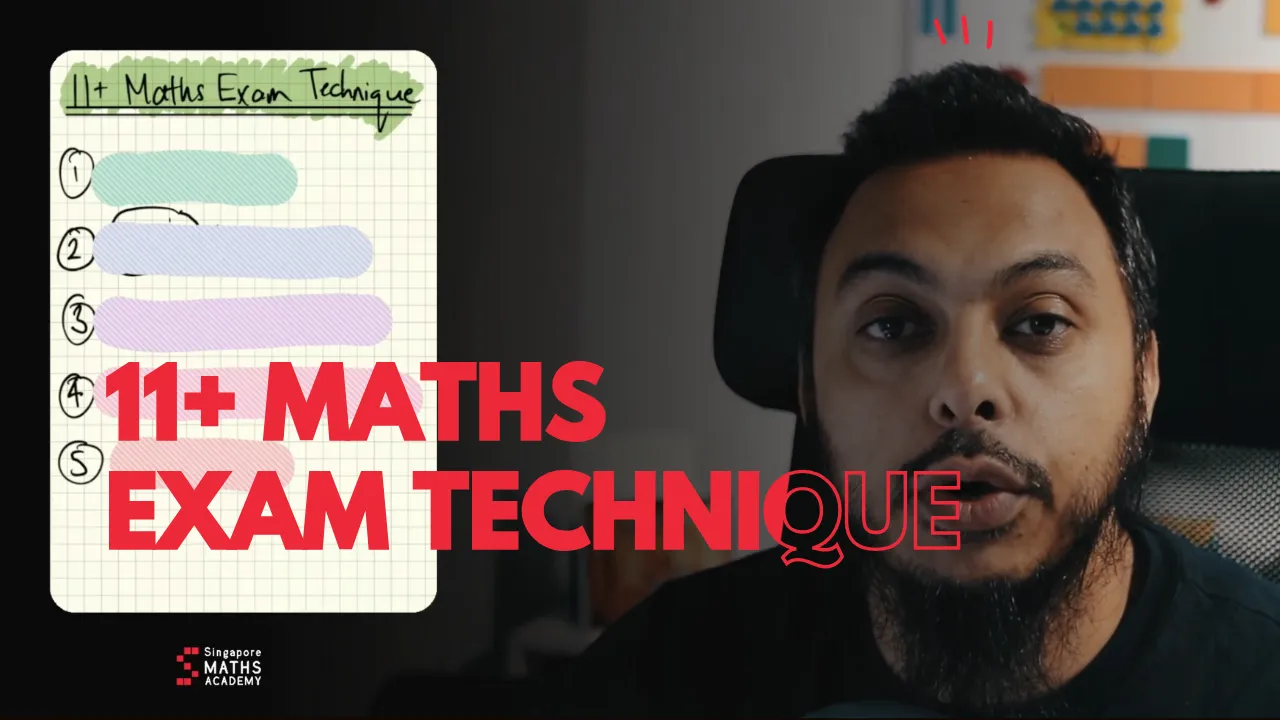
Top 5 Eleven Plus Maths Exam Technique Tips
Preparing for the 11 Plus maths exam can be a big challenge, not only for students but for parents too. Whether you’re guiding your child through their studies or your child is working on their own, knowing the right exam techniques can make a huge difference — both in improving accuracy and saving valuable time during the test.
In this post, we’re diving deep into five essential exam technique tips that help students avoid common mistakes and boost their scores. These practical strategies are easy to understand and apply, and they’ve helped many families navigate through the final stretch of exam preparation.
Let’s explore each tip in detail, with real examples and visuals to bring these ideas to life!
Table of Contents
- Visualisation
- Estimation Skills
- Avoiding The “Rock” Questions
- Circle and Move On
- Underlining Key Information
- Recap of Strategies
- Final Thoughts & Next Steps
Visualisation
Visualisation is the first must-have strategy and it’s especially helpful for those last-minute cramming sessions or for students who struggle with abstract maths concepts. When your child reads a problem, encourage them to turn the numbers and words into pictures — bars, diagrams, or even tables.
Why Visualisation Works
Many students find tricky algebra or complex word problems easier to grasp when they “see” the situation instead of just trying to imagine it. Visual tools make relationships and proportions stand out. Here’s a classic type of question:
“A has two times as many sweets as B. Altogether, they have 30 sweets. How many does A have?”
Let’s break this down:
- Draw bars to represent each person’s sweets.
- B = one bar, A = two bars (twice as many).
- Total sweets = 3 bars
So:
30 (total sweets) ÷ 3 (bars) = 10 sweets per bar- B has 10 sweets.
- A has 20 sweets (twice B).
- Together: 20 + 10 = 30 sweets.
This visual approach lets students see relationships clearly, cuts down on mistakes, and gives them a way to check their answers.
“”
Other Visual Techniques
- Bar Modelling (Consistent in Singapore Maths, and a favourite here!)
- Drawings & Diagrams
- Tables
If your child finds algebra tricky or you’re short on time, starting with visualisation is a smart move. We even offer a bar modelling visualisation course — a great resource to work through together!
“Visualisation, whether it’s mentally or writing it down, helps make those tricky questions much clearer.”
Estimation Skills
Estimation isn’t just about getting a quick, rough answer. It can be a real timesaver on exam day and often helps students pick the right answer even when they’re not sure.
Using Estimation in Multiple Choice
Most 11 Plus maths exams (especially the GL style) are multiple choice with five options for each question. If the answers are very different from each other, estimation can quickly rule out wrong choices and help find the right one fast.
Try using estimation when:
- You’re running out of time
- The options vary noticeably
- Making lots of calculations might lead to errors
“”
Let’s say you don’t need perfect accuracy. If your estimated answer is close to one of the choices (and miles away from the rest), that’s probably your best bet!
Example:If you’re asked how many apples are in 7 baskets averaging about 10 apples each, estimate 70 apples even if you don’t know each basket’s exact count.
Practice Makes Perfect
Encourage your child to practise estimation skills using past papers and real exam questions. Genuine 11 Plus past papers are much better than third-party mocks — they give a real taste of exam style and difficulty.
“Estimation can save you a huge amount of time, especially when the options are very different.”
Check out our other videos on YouTube or TikTok — we show two brilliant examples where estimation works wonders!
Avoiding The “Rock” Questions
You know that feeling — you’re breezing through your questions and then suddenly hit a really tough one. We call these “rock” questions because they feel impossible to move past, and many students end up stuck here, wasting vital minutes.
Where Are The Rocks?
Surprisingly, the hardest questions aren’t always at the end. Sometimes you’ll find them:
- Right before the last few questions
- Sneaking in somewhere in the middle
- Occasionally near the start (especially in recent CSSE exams)
“”
What Happens If You Get Stuck?
It’s easy to lose track of time. Imagine this scenario:
- Confidently solve questions 21, 22, 23…
- Suddenly get stumped by question 24.
- Spend 10 minutes without progress.
- Race through 28, but get stuck again at 29 — with only five minutes left.
If you burn too long on a single question (especially in the GL exam, where every question is worth one mark), you risk losing out on easier marks elsewhere.
“There’s no point spending an excessive amount of time on one question when it’s only worth one mark.”
Circle and Move On
The next tip is a practical strategy: circle the tough questions and move on. This simple habit keeps students moving and ensures precious minutes aren’t wasted.
How Does This Work?
When your child hits a challenging question:
- Circle the question number.
- Skip to the next question.
- Finish all the others first.
If there’s time left at the end, use it to come back and give those circled questions another go. This is especially important for one-mark questions — don’t let one tough problem steal time that could earn you more marks elsewhere.
“”
Stay Organised — Avoid Answer Sheet Errors
A BIG warning here:
In the GL exams, answers are often filled in on a separate sheet. If you’re circling and jumping around, you might fill out the answer for question 25 in the box for question 24. This can create a chain reaction of errors!
To avoid mix-ups:
- Mark the sheet or write notes on the side.
- Only circle what you’re confident you’ll skip and revisit.
- Double check numbering before moving on.
“You have to be really careful with answer sheets. A small mix-up can lead to lots of mistakes!”
Underlining Key Information
As obvious as it sounds, underlining (or highlighting) the important parts of a question can make answering much faster, especially if you have a huge, wordy problem. This tip means you won’t need to repeatedly re-read the question to find key numbers or instructions.
What Should You Underline?
Not everything — just the essentials:
- Important numbers
- Key facts
- Units (minutes, cm, £, etc.)
- Final instructions or twists
Here’s an example:
James arrives at Edinburgh Airport at 13:05.
It takes 27 minutes to get from plane to baggage claim.
Then, it takes him 45 minutes to reach the railway station.
The question:
“How long does he have to wait for the next train to St Andrews?”
“”
You’d underline or highlight:
- 13:05
- arrives
- 27 minutes
- 45 minutes
- The phrase: “how long does he have to wait”
That way, you can quickly scan for what you need when working out the answer (especially in complex, multi-step word problems).
If highlighters are allowed, use them instead!
Why Underline?
- Faster to find facts on re-reading
- Saves time on tricky, multi-part questions
- Makes checking answers simpler
- Stops you from missing sneaky changes (“wait for” vs “duration”, etc.)
“Highlighting key parts of the question is a really sensible thing to do.”
Pro Tip: Don’t go overboard. Underlining or highlighting everything wastes time. Focus on numbers and the twist at the end.
Recap of Strategies
Let’s revisit our five exam technique tips:
1. Visualisation
- Bar modelling, diagrams, tables
- Helps see relationships clearly
- Great for those who struggle with algebra
2. Estimation
- Useful when options are very different
- Saves a huge amount of time
- Practice using past papers and real exam questions
3. Avoid the “Rock”
- Identify tough questions and don’t get stuck
- Don’t waste lots of time on one-mark questions
4. Circle and Move On
- Circle challenging questions, finish the rest
- Come back if time allows
- Be careful with answer sheets (especially GL exams)
5. Underlining Key Information
- Underline/hightlight only the crucial facts, not the whole question
- Makes multi-step problems much quicker to solve
- Focus on numbers, units, and critical instructions
“”
The combination of these strategies can dramatically improve your child’s confidence, speed, and accuracy in the final weeks before the 11 Plus.
Final Thoughts & Next Steps
Putting these five tips into action isn’t just for last-minute preparation — they’re good habits for any maths exam. By saving time and avoiding common mistakes, your child will have extra minutes to tackle the harder questions at the end.
If you have any questions, drop us an email or leave a comment below. You can also explore more exam technique resources and visualisation courses on our website, or watch our helpful video walkthroughs on YouTube and TikTok.
Of course, the best way to ace your 11 Plus is to practise regularly with real exam papers. Try using these tips during practice so they become second nature by exam day.
More Resources
“If you follow these five steps, you’ll save a huge amount of time in your final 11 Plus exam, giving you a real edge for those more challenging questions.”
