
Hey, everyone! If you’re getting ready for your 11+ exams or helping your child prepare, you’ll want every trick in the book to make the most of your time during the test. Today, let’s dig deep into a typical 11+ maths problem and learn how to use estimation to blast through tricky questions—especially when you’re running out of time.
Grab a snack and settle in, because this blog is jam-packed with practical tips, step-by-step calculations, and loads of visuals: everything you need to master estimation for the 11+.
Table of Contents
- Introduction: Why Estimation Matters
- The Sample Problem
- Initial Thoughts: Spotting Estimation Opportunities
- Step-by-Step: Estimating the Pocket Money
- Crunching the Paper Round Earnings
- Combining Your Estimates
- Shortcuts for Multiple Choice Questions
- Why Estimation Saves You Time
- Tips for Developing an “Estimation Mindset”
- Practising with Real 11+ Problems
- Common Mistakes & How to Avoid Them
- Final Thoughts: Exam Day Strategy
- Join the Conversation!
Introduction: Why Estimation Matters
It’s no secret: timing is everything in the 11+ exam! As you edge closer to the end of the paper, that clock starts ticking faster and panic might set in. You spot a question with heaps of numbers and think, “This could take ages!” But what if you didn’t have to get the answer to the exact penny?
Estimation is your secret weapon. It lets you:
- Quickly narrow down your choices,
- Avoid silly mistakes,
- And squeeze out those precious last marks—maybe even the one needed for your place at grammar school!
“You don’t have to be so precise, because if you look at the answers… there’s quite a big difference between them, right?”
You might have heard a teacher say something similar. If not, you’re reading it now!
The Sample Problem
Let’s start with the exact question from our transcript:
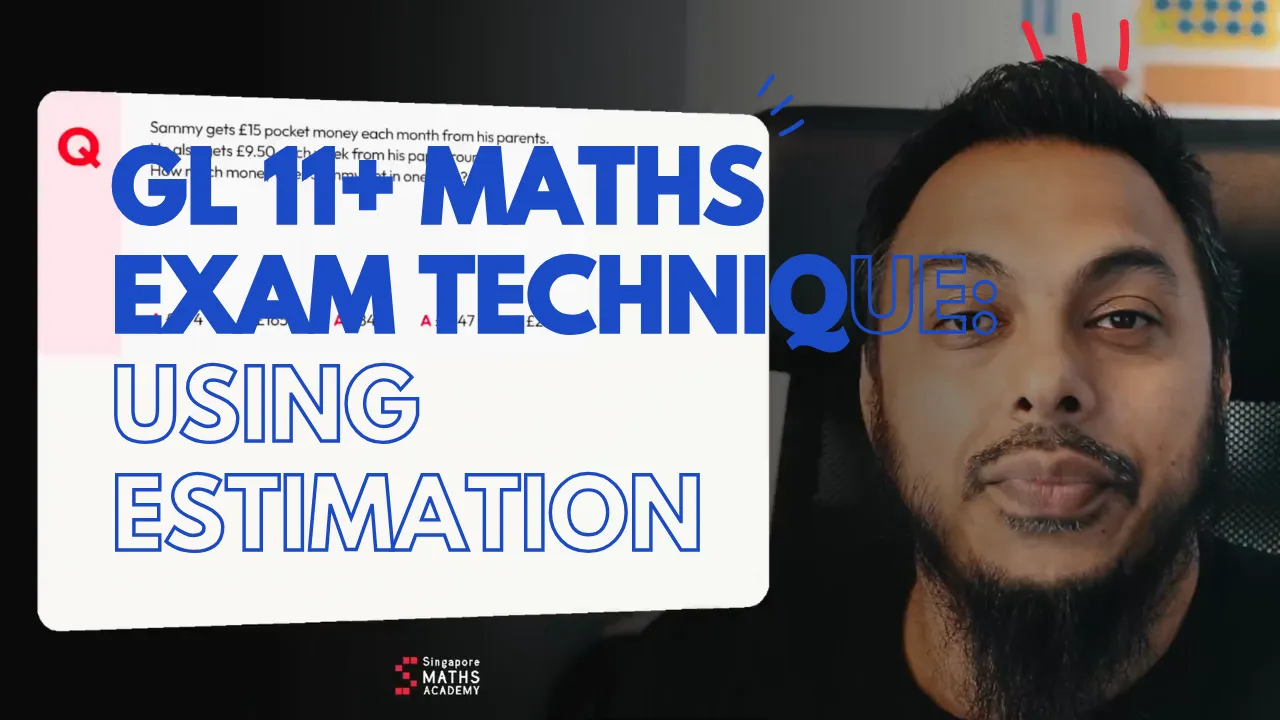
“Sammy gets £15 pocket money each month from his parents. He also gets £9.50 each week from his paper round. How much money does Sammy get in one year?”
There’s a reason questions like these pop up near the end of 11+ maths papers—they make you juggle monthly and weekly calculations, and if you’re short on time, it’s easy to get stuck.
Here’s how we’ll attack it, step by step.
Initial Thoughts: Spotting Estimation Opportunities
First, when you see a question like this, don’t panic. Instead, look at the possible answers (if it’s multiple choice). The transcript gave these options:
- £60
- £674
- £1,656
- £849
- £1,347
- £249
Whoa! That’s a massive spread, isn’t it? You don’t need the exact answer to know that £60 is way too low and £1,656 is likely too high. This is your first clue: estimation is not just allowed, it’s essential.
Quick tip: If the options have big gaps between them, don’t waste time trying to be perfect.
Step-by-Step: Estimating the Pocket Money
Let’s break down the pocket money calculation—monthly earnings.
Sammy gets £15 each month.
How much does that add up to in one year? Well, there are 12 months in a year.
Let’s work this out:
£15 × 12 = ?You could grab your calculator, but we want to save time.
Fast Mental Calculation
Split 12 into 10 and 2:
- 15 × 10 = £150
- 15 × 2 = £30
- Add them: £150 + £30 = £180
So, from just the pocket money, Sammy gets £180 per year.
(Visual: Stack of coins or a 12-month calendar with £15 marked each month)
Crunching the Paper Round Earnings
The question also says Sammy gets £9.50 each week from his paper round.
There are 52 weeks in a year, so in theory:
£9.50 × 52 = ?Method 1: Going Through the Full Calculation
Splitting £9.50 into £9 and £0.50 (50p):
- £9 × 52 = £468
- £0.50 × 52 = £26
- Total = £468 + £26 = £494
But wait! In an exam, full calculations like this can eat up your time. Is there a smarter way?
Method 2: Estimation for Speed
Is £9.50 close to a round number? YES! It’s nearly £10.
Think of it as £10 × 52 = £520.
But… Since £9.50 is 50p less than £10, every week Sammy gets 50p less than £10.
Total difference over 52 weeks:
- 0.50 × 52 = £26
So, from the over-estimate:
- £520 (if he got £10 each week)
- Subtract £26 (the “overestimate”)
So, real total for the year: £494 (same as above).
“Nine pound fifty is very close to ten pounds. And so ten times fifty-two is five hundred and twenty.”
Key estimation tip: Round to the nearest simple number, then adjust at the end if needed!
Combining Your Estimates
Right, now let’s add Sammy’s two sources of income—for the full year.
- Pocket money: £180
- Paper round: £494 (if you calculated exactly) or roughly £520 (if you estimate high)
Let’s do both, so you get comfortable with estimation and then checking your answer.
Estimate First
- £180 (pocket money)
- £520 (paper round, estimated high)
Total: £180 + £520 = £700 (estimated upper limit)
But wait, we know £520 is a bit too high because we rounded up.
Accurate Calculation
- £180 + £494 = £674
So a precise total (doing the full calculation) is £674.
(Visual: Two bar charts side by side — estimation vs actual, to illustrate the difference)
Shortcuts for Multiple Choice Questions
Let’s remember those answer choices:
- £60
- £674
- £1,656
- £849
- £1,347
- £249
If you have a smart estimate of around £700, only £674 makes sense. All the other options are way off—either much too high or much too low.
“…the only feasible answer in a very short space of time is going to be 674. I know that because I’ve said my answer be less than 700. It’s only two possible answers less than 700. One of them is way less. And obviously that’s not going to be an appropriate answer.”
See how estimating first helps you eliminate wrong answers fast?
Why Estimation Saves You Time
Let’s put yourself in the shoes of the exam.
With just a few minutes to go, do you want to spend your time multiplying decimals and double-checking every penny, or do you want to collect as many marks as possible?
Here’s why estimation is so powerful:
- It acts as a sense-check: Stops silly mistakes (like miscounting months or weeks)
- It helps eliminate impossible options in multiple choice
- It frees up time for really tricky problems where you do need exact answers
When to Use Estimation
- When numbers are round or close to round
- When options are spread far apart
- When you’re running out of time
- When you just need to rule things out
Pro tip: “Not like crazy estimations, just sense of estimation so that my answer can be, you know, taken very quickly and I don’t have to go through every single process and I don’t have to be so accurate that it takes a lot of my time…”
Tips for Developing an “Estimation Mindset”
It’s not just about this question—it’s about making estimation second nature. Here’s how you can train your brain to estimate quickly and effectively:
1. Practise Rounding Up and Down
- If a number is £9.50, think “Is this closer to £10, or £9?”
- Sometimes rounding up gives a safer estimate—so long as you remember it’s an OVER-estimate.
2. Break Big Multiplications into Easier Pieces
- e.g., For 15 × 12, split 12 into 10 + 2:
- 15 × 10 = 150
- 15 × 2 = 30
- Total: 150 + 30 = 180
3. Use “Friendly Numbers”
- Think in 10s, 50s, 100s. They’re easier and quicker to work with in your head.
4. Quickly Sense-Check
- If your estimate is way higher or lower than any answer, double-check—did you round in the wrong direction?
5. Eliminate the Impossible
- If you know the total has to be more than £200, cross out £60 and £249 straight away.
- If you know it can’t possibly be over £1,000, cross out those numbers too.
Practising with Real 11+ Problems
Let’s try a few other similar estimation challenges, so you cement the skills. Adapt these for your own revision or with your child!
Example 1: Weekly and Daily Allowance
Jamie gets £10 every week and £2 every day during school holidays (14 weeks/year). How much does Jamie get in a year?
Estimate:
- £10/week x 52 weeks = £520
- £2/day x 7 days/week x 14 weeks = £2 x 98 = £196
Total: £520 (round to £500 if you’re rushing)
Add £200 (from £2/day during holidays)
Final estimate: About £700
Example 2: Saving With Estimation
A board game costs £13.45. If you want to buy five, about how much will it cost?
- £13 × 5 = £65 (if you round down)
- £15 × 5 = £75 (if you round up)
The answer will be between £65 and £75—probably closest to £67-ish.
Common Mistakes & How to Avoid Them
Even the best students slip up now and then. Here are the top estimation mistakes and how you can dodge them:
Mistake 1: Not Rounding Correctly
Not sure if you should round up or down? Ask yourself: do I want to be sure my answer isn’t too high or too low? For test questions, it’s usually okay to round up when in doubt, as long as you adjust at the end.
Mistake 2: Forgetting to Adjust
If you round £9.50 up to £10, remember to fix that at the end by subtracting the extra you “added”.
Mistake 3: Not Checking the Big Picture
If you work out that the answer is £1,234 but the biggest option is £500, you need to look again!
Mistake 4: Panicking and Freezing
Remember, sometimes good enough is good enough. Especially at the end of a test, it’s better to estimate and pick the best answer than leave it blank.
Final Thoughts: Exam Day Strategy
Exams are as much about technique as they are about maths knowledge. Smart estimation gives you those crucial marks when time is against you.
“So hopefully this has helped you… exam technique is so important.”
Remember, the 11+ isn’t just about working things out perfectly—it’s about doing your best under pressure. Use estimation as a tool and not a crutch. Practise it at home, so come exam day, it’s second nature.
Quick Checklist for Using Estimation in the Exam
- [ ] Check if the answers are widely spaced (then estimate!)
- [ ] Look for friendly numbers to round to
- [ ] Use addition, subtraction, and multiplication tricks to make sums super quick
- [ ] Sense-check your answer against what should be reasonable
- [ ] Move on quickly to the next question if you’re happy with your estimate
(Visual: Quick estimation checklist, e.g. exam desk with a clock and maths paper)
Join the Conversation!
If this blog post helped you, let us know! Drop a comment below sharing your top estimation tip or a question you’d like answered in a future post.
If you’re prepping for the 11+ and want more advice, resources, or just a bit of encouragement, reach out! We’re always happy to help make your prep as smooth and successful as possible.
“If you still needed some help, please get in contact and we would love to support your child.”
Best of luck with your studies. Remember—you can do this! And smart estimation might be just the ticket to your top score.
Take care, and see you in the next blog!
(Visual: Smiling student with a stack of books marked “11+ Practice”)
Resources for Extra Practice
Share Your Thoughts!
Have questions or tips about estimation? Share them in the comments below, or contact us directly.
And if you found this useful, don’t forget to like and share—more students should have the confidence to estimate and succeed!
“Not like crazy estimations, just sense of estimation so that my answer can be, you know, taken very quickly and I don’t have to go through every single process…”
You’re one step closer to beating the 11+ maths with confidence!
