
Bar models are one of the most powerful tools in primary maths education — and the good news for parents is that you do not need a teaching qualification to use them effectively at home. Learning how to teach bar model at home takes a little practice, but the method is logical, visual, and surprisingly straightforward once you understand the underlying structure.
What Is the Bar Model Method?
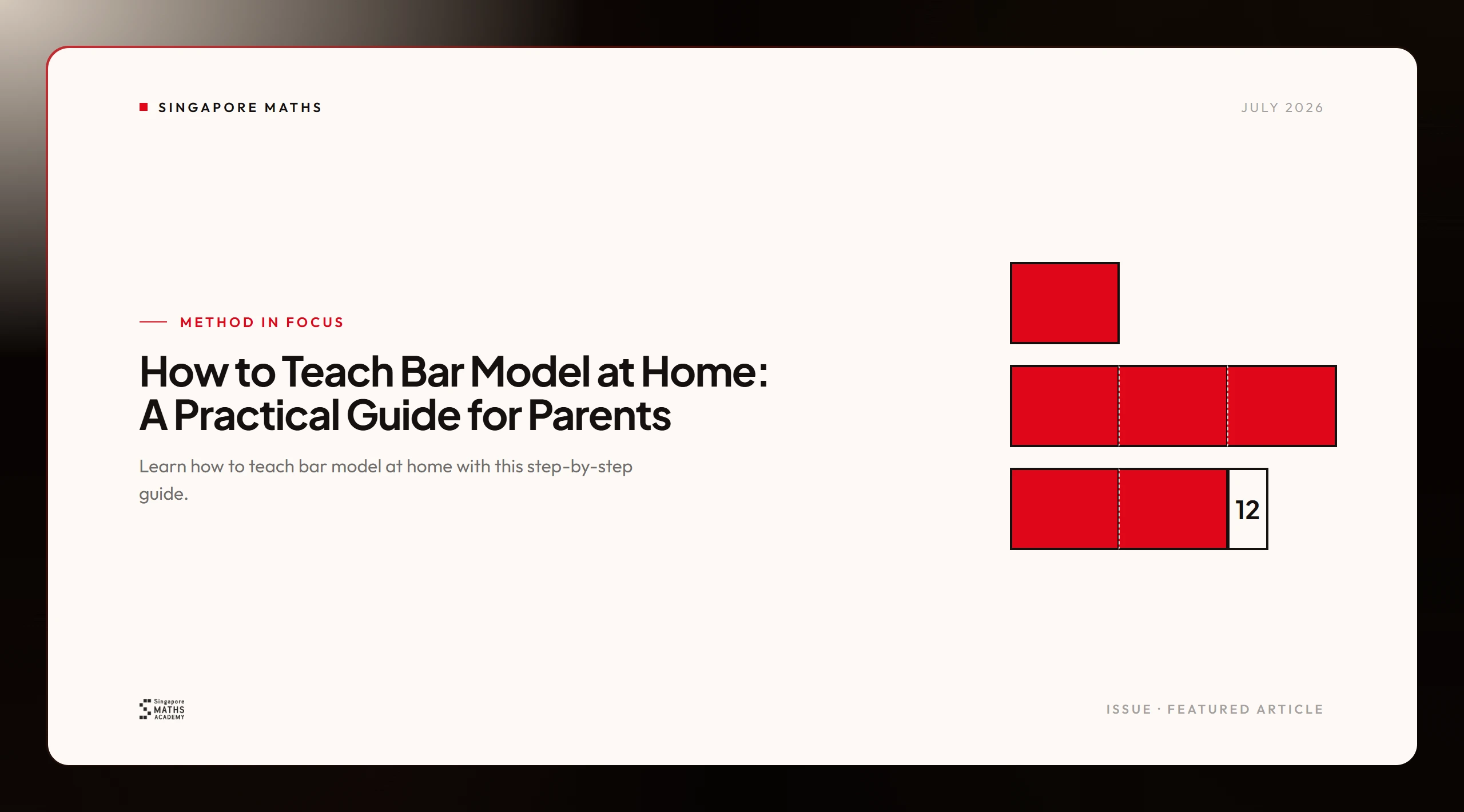
The bar model method uses rectangular bars to represent known and unknown quantities in a maths problem. Rather than jumping straight to number sentences, students draw bars proportional to the values involved, creating a visual picture of the relationship between numbers. This makes abstract concepts — fractions, ratios, proportions, and multi-step problems — far more accessible to primary-age children.
It is the backbone of Singapore Maths, and the reason it works so well is that it sits at the heart of the Concrete–Pictorial–Abstract (CPA) approach: pupils move from handling physical objects to drawing pictorial representations, and only then to writing symbolic equations. You can read more about the foundations of this progression on the Bar Model Company website, which offers teacher training and parent resources on bar model pedagogy.
Getting Started: The Two Basic Bar Types
Before you sit down with your child, it helps to know that all bar model work builds from two core structures:
The Part-Whole Model
Used when you know the total and need to find one of the parts, or when you know the parts and need to find the whole. Draw one large bar divided into sections. Label the sections you know and place a question mark on the section you are finding.
The Comparison Model
Used when you need to compare two or more quantities. Draw separate bars of different lengths, aligned to a common start point. The difference between them becomes visible — and the question almost answers itself.
How to Teach Bar Model at Home, Step by Step
When introducing bar models to your child, keep the problems simple at first. The aim is to build the habit of drawing before calculating, not to rush to a correct answer.
Step 1: Read the problem together
Read the question aloud. Then ask your child: “What do we know? What are we looking for?” Writing these down side by side helps enormously. Children who identify the known and unknown quantities before drawing make far fewer errors.
Step 2: Choose the bar structure
Is this a problem about parts adding up to a whole? Or is it asking your child to compare two values? These two questions determine which bar type to draw. You do not need to use technical terms with younger children — simply ask whether the problem is about “putting together” or “comparing”.
Step 3: Draw proportionally
Encourage your child to draw bars that roughly reflect the size of the numbers involved. If one value is three times the other, the bar should look three times as long. This proportional thinking is actually doing part of the mathematical reasoning — it is not decoration.
Step 4: Label and calculate
Once the bars are drawn and labelled, the calculation usually becomes obvious. A child who has drawn an accurate bar model rarely needs to be told what operation to use — the picture shows them.
A Worked Example
Consider this typical Year 5 problem: “Amara has 48 sweets. She gives her brother twice as many as she keeps. How many does she keep?”
Draw one bar for Amara’s share and two equal bars for her brother’s share, lined up together. All three equal sections total 48. Each section is therefore 16. Amara keeps 16 sweets.
No algebra. No guessing. The picture does the thinking.
For more worked examples like this, the Singapore Maths Academy YouTube channel has a growing library of problem walkthroughs using bar models at different year-group levels.
Common Mistakes to Avoid at Home
The most frequent error parents make is reaching for the calculation before drawing the bars. If your child can already get the right answer without a bar model, that is fine — but encourage them to draw it anyway. The habit of visual representation pays significant dividends when the problems become more complex in Year 5, Year 6, and beyond.
Resist the temptation to teach shortcuts or tricks alongside the bar model. The Singapore approach deliberately prioritises understanding over speed, and rushing to shortcuts undermines the very foundations the bar model is building.
When Bar Models Are Most Valuable
Bar models are particularly effective for the following problem types that appear regularly in 11+ papers and primary assessments. For a deeper look at the method itself, our post on the bar model method in maths covers the full range of structures and how they develop across year groups.
The problem types where bar models make the biggest difference include:
- Multi-step word problems involving addition and subtraction
- Ratio and proportion problems
- Fraction-of-an-amount calculations
- Problems involving two unknowns with a known total
- Before-and-after problems (a quantity changes — what is it now?)
Research consistently shows that children who use visual representations in maths develop stronger problem-solving skills. Bar modelling is not limited to addition and subtraction — it is equally effective for multiplication, division, fractions, percentages, and ratio problems.
Supporting Your Child Alongside Specialist Tuition
Practising bar models at home is most effective when it reinforces what your child is learning in their maths lessons. At Singapore Maths Academy’s 11+ and primary tuition, bar modelling is central to the way we teach from Year 3 onwards. Our tutors use the same structures your child is building at home, so the two reinforce each other naturally.
If you would like your child to work with tutors who specialise in this approach, we would be glad to talk through what would suit them best. Get in touch to find out more about our primary and 11+ groups.
