
What Is the Bar Model Method in Maths?
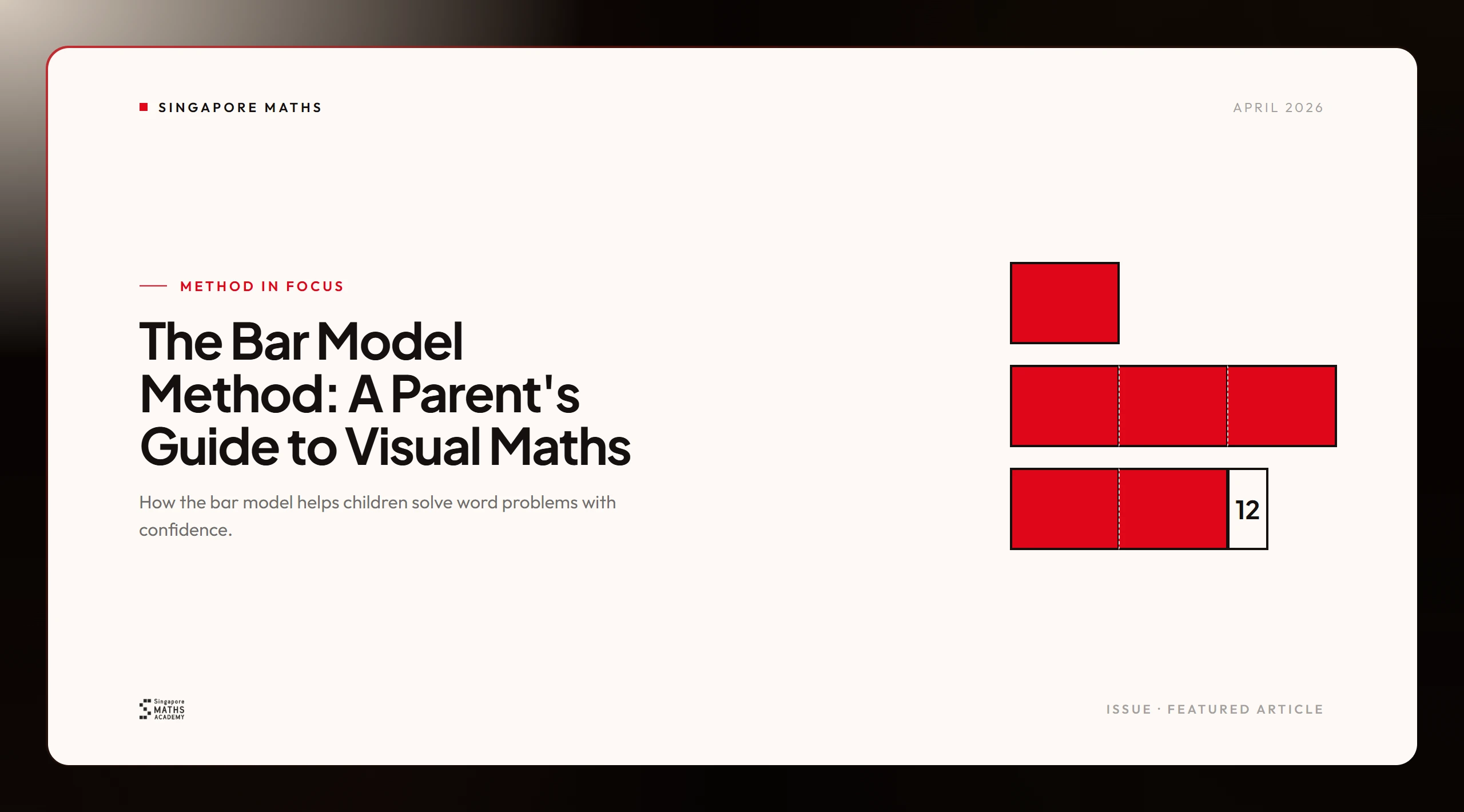
If you have spent any time looking into how your child is being taught maths — whether at primary school, in 11+ preparation, or through a tuition provider — you have probably come across the term bar model method maths. It sounds technical, but the idea behind it is beautifully simple: use a rectangle, or a series of rectangles, to represent a maths problem visually before attempting to solve it.
Bar modelling is central to the Singapore Maths approach, which is widely regarded as one of the most effective frameworks for teaching mathematical reasoning in the world. Rather than jumping straight to abstract numbers and equations, children first build a mental picture of what a problem is actually asking. The bar model is the tool that makes that picture possible.
Why Does Bar Modelling Work So Well?
Most children who struggle with maths word problems are not struggling with maths — they are struggling with the translation from words to numbers. A sentence like “Amara has three times as many stickers as Ben, and together they have 48 stickers” contains real mathematical structure, but if a child cannot see that structure, they cannot solve the problem.
The bar model method gives children a way to draw out what is happening. They represent Amara’s stickers as three equal units and Ben’s as one, label the total as 48, and suddenly the calculation is straightforward. No guesswork. No panic. Just a clear, logical path from question to answer.
This is why bar modelling is used so extensively in Singapore Maths curricula, and why it is increasingly common in UK primary schools following the Maths Mastery approach. It builds the kind of deep, flexible thinking that leads to genuine understanding rather than rote procedure.
Bar Models in 11+ Maths Preparation
For families preparing for the 11+ examination, the bar model method is particularly valuable. The 11+ — whether GL Assessment or CEM format — tests children’s ability to reason mathematically, not just recall procedures. Word problems, ratio questions, and problems involving fractions are common, and these are precisely the question types where bar modelling gives children a real structural advantage.
A child who has internalised bar modelling does not need to hold a complex problem in their head all at once. They externalise the structure onto paper, identify the unknown, and work methodically from there. That calm, systematic approach is exactly what examiners are looking for — and it is a skill that can absolutely be taught.
Common 11+ Question Types That Suit Bar Models
- Part-whole problems: How do the parts relate to the total?
- Comparison problems: How much more or less does one person have than another?
- Ratio and proportion: If two quantities are in a given ratio, what is each worth?
- Fraction of an amount: What is three-quarters of a given whole?
- Multi-step word problems: Problems with several connected pieces of information.
Bar Models at GCSE Level
The bar model method is not just a primary school technique. Its underlying principle — represent the problem visually before solving it — is just as relevant at GCSE. Students who have built a solid grounding in bar modelling at primary level often find algebraic thinking at secondary level more intuitive, because they already understand the concept of unknowns and how they relate to known values.
At Singapore Maths Academy, we work with students across both 11+ and GCSE levels, and we see the lasting benefit of a bar model foundation clearly. Students who can draw out a problem before they solve it make fewer errors, catch their own mistakes more readily, and approach unfamiliar question types with far more confidence.
How to Introduce Bar Modelling at Home
You do not need to be a maths teacher to support your child with bar modelling. Here are a few straightforward steps to start:
Start With Simple Addition and Subtraction
Draw a long rectangle and label it with the total. Divide it into two sections and label each part. Ask your child: if we know the total and one part, how do we find the other? Keep it very concrete to begin with — sweets, books, football cards, whatever captures their interest.
Move on to Comparison Models
Draw two bars of different lengths. One represents “more” and one represents “less.” Label what you know and identify the gap. This is the structure behind every “how many more?” question your child will ever encounter.
Introduce Ratio Models
Once your child is comfortable with part-whole models, introduce equal-unit bars. If something is shared in a ratio of 2:3, draw two units for one quantity and three for the other. The total number of units multiplied by the value of one unit gives the answer.
Let Them Draw It Themselves
The goal is for your child to reach for the bar model instinctively when they see a word problem. The best way to build that habit is to let them draw it themselves — not for you to draw it for them. Ask guiding questions: “What do we know?” “What are we trying to find?” “Can you show that with a rectangle?”
What Good Bar Model Teaching Looks Like
The bar model method is most effective when it is taught systematically alongside the Concrete-Pictorial-Abstract (CPA) progression that underpins Singapore Maths. At the concrete stage, children use physical objects — counters, cubes, blocks — to represent quantities. At the pictorial stage, they draw the bar model. At the abstract stage, they translate that model into an equation.
Each stage builds on the last. A child who has physically handled ten cubes before drawing a bar of ten before writing the number 10 has three reinforcing layers of understanding. When that child later encounters ten as a variable in an algebra problem, the concept is already familiar.
This is the Singapore Maths approach in its fullest form — not a collection of tricks, but a carefully sequenced journey from the tangible to the abstract. The bar model is the bridge between the two.
Frequently Asked Questions
At what age should my child start using bar models?
Bar modelling is typically introduced in Year 2 or 3 in Singapore-method schools, though children can start as young as Year 1 with very simple part-whole models. There is no upper age limit — students use variations of bar modelling well into secondary school.
Is bar modelling used in UK state schools?
Yes, increasingly so. The Maths Mastery approach, which has been widely adopted across UK primary schools since 2016, incorporates bar modelling as a core strategy, particularly for word problems and reasoning tasks.
Does bar modelling help with the 11+ specifically?
Significantly, yes. The 11+ places considerable emphasis on mathematical reasoning and multi-step word problems — exactly the question types where bar modelling gives children the clearest structural advantage.
What if my child already has a different method that works for them?
Bar modelling is not a replacement for other sound strategies — it is an additional tool. If your child is already strong at a particular question type, there is no need to change approach. But for word problems where they are less confident, bar modelling often provides the breakthrough.
How is bar modelling taught at Singapore Maths Academy?
Our tutors introduce bar modelling as part of our structured Singapore Maths curriculum, starting with part-whole models and progressing through comparison, ratio, and multi-step problems. We teach it in context — always connected to real exam-style questions — so children learn when to reach for it and how to use it efficiently under time pressure.
Ready to Give Your Child a Real Advantage?
If you would like your child to develop confident, structured mathematical thinking — the kind that serves them in the 11+, at GCSE, and far beyond — we would love to show you how Singapore Maths Academy can help. Our small groups and expert tutors mean your child gets real attention, real progress, and real results.
Contact us today and see the difference structured thinking makes.
