
If you have looked into Singapore Maths or spoken to a primary school teacher in recent years, you have probably encountered the term CPA. It is one of the most talked-about ideas in mathematics education — and one of the most misunderstood. The CPA approach in maths is not a specific programme or a set of worksheets. It is a principled sequence for how mathematical understanding should be built, and getting that sequence right makes a substantial difference to how confidently and capably children learn.
What Does CPA Stand For?
CPA stands for Concrete–Pictorial–Abstract. The three stages describe the progression from physical, hands-on experience of a mathematical idea, through visual representation, to the symbolic notation — the numbers, letters, and operations — that we usually associate with “doing maths”.
Rather than asking children to memorise abstract rules and formulas from the outset, the CPA approach starts with hands-on experience, moves to visual representation, and only then introduces the symbolic notation that most of us associate with proper mathematics. This progression mirrors how the human brain naturally learns, which is why it produces such strong results.
The Three Stages Explained
Concrete
Children begin by physically handling objects — counters, cubes, number rods, fraction tiles — to experience the mathematical concept in a direct, tangible way. When a child counts out twelve counters and splits them into groups of three, they are not yet doing abstract division. They are building a physical understanding of what division actually means: equal sharing, grouping, repeated subtraction.
This stage is particularly important for young children and for any student encountering a genuinely new concept. Even older students benefit from returning to the concrete stage when a new idea proves difficult — there is no shame in going back to physical objects to build understanding before moving forward.
Pictorial
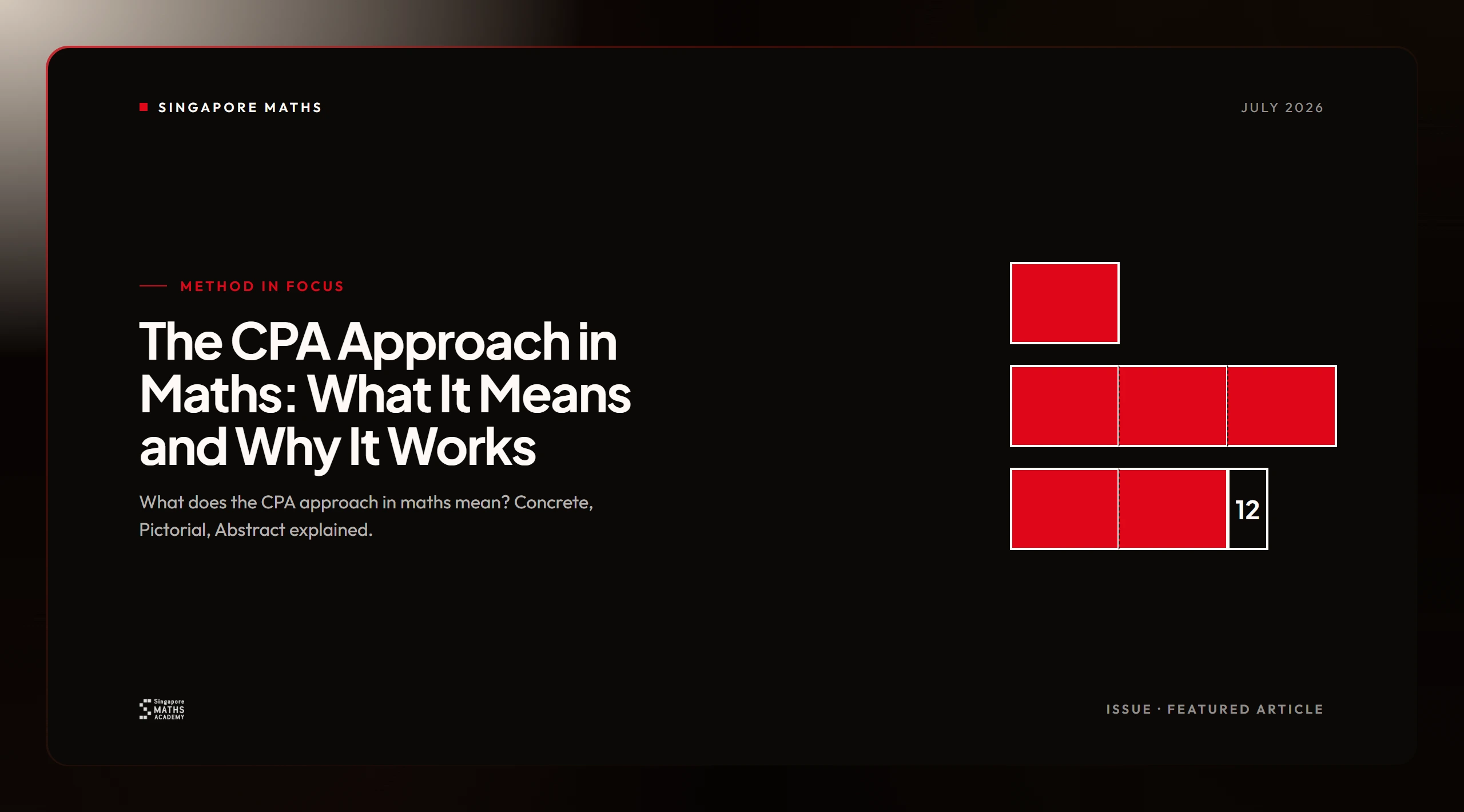
Once a concept is understood concretely, students move to representing it visually. This is where the bar model becomes an essential tool. A bar model translates the physical groupings, comparisons, and relationships from the concrete stage into a drawn diagram — without yet requiring any symbolic equation.
The pictorial stage is the bridge between the physical world and the mathematical one. Children who learn to represent problems visually develop much stronger problem-solving skills because they can see the structure of a problem before they commit to a calculation. You can find more about how bar modelling works in practice at the Bar Model Company, which specialises in training teachers in CPA pedagogy.
Abstract
Only after a student can represent an idea concretely and pictorially are they ready to work with pure symbols — numbers, operation signs, equations, and variables. At this point, the abstract notation is not arbitrary: it is a shorthand for something the student already understands in two other forms.
This is the critical distinction between the CPA approach and traditional rote learning. A child who has been rushed to the abstract stage without the earlier stages may be able to reproduce a procedure, but their understanding is fragile. Ask them to apply the same idea in an unfamiliar context and it often falls apart. A child who has moved through all three stages rarely has this problem.
Why the CPA Approach in Maths Works
Singapore has consistently ranked at or near the top of international maths assessments such as TIMSS and PISA. The CPA approach — originally developed by the psychologist Jerome Bruner and formalised into the Singapore curriculum — is one of the most consistently cited reasons for that performance. Schools implementing mastery approaches based on CPA principles have reported significant gains in both attainment and student confidence.
The approach also aligns naturally with what UK 11+ and GCSE papers now demand. Both the 11+ and the reformed GCSE assess reasoning and problem-solving rather than procedure recall. A student trained on CPA is genuinely better equipped for these tests — not just because they know more, but because they understand what they know.
For a deeper look at the broader Singapore Maths philosophy, our post on what Singapore Maths is and how it works gives useful background.
How CPA Is Applied at Different Stages
The CPA approach is not a fixed formula applied identically at every age. At Singapore Maths Academy, we apply it in a tiered way that reflects where students are in their mathematical development:
- Year 3 and primary: CPA is at the core of everything. Bar models, physical manipulatives, and pictorial representations are used consistently throughout.
- Year 4–5 (11+ preparation): CPA is used wherever possible. The pace of 11+ preparation means there is a push toward the abstract, but the pictorial stage remains essential for problem-solving.
- KS3 (Years 7–9): CPA continues but students are gradually transitioned to more abstract methods as their foundations mature and the topics become more algebraic.
- GCSE: Primarily abstract. CPA is available as a grounding tool when a genuinely new topic needs it — but students at this level have the foundations to work abstractly with confidence.
This progression is honest about what CPA is for: it builds understanding when understanding is being built. Once it is secure, students move forward — which is exactly what the approach is designed to produce.
CPA and the Bar Model: Two Sides of the Same Approach
The bar model is the most visible expression of the pictorial stage in CPA. It is the tool that most parents encounter first, and it is the one most directly applicable to the kinds of multi-step word problems that appear in 11+ papers and KS3 assessments.
Understanding CPA gives bar models their context. The bar model is not a standalone trick — it is the pictorial representation that sits between physical understanding and symbolic calculation. Used correctly, it is one of the most powerful tools a primary-age student can have.
For a closer look at how bar modelling works in practice — including worked examples you can use at home — see our post on the bar model method in maths.
Working with Tutors Who Specialise in CPA
At Singapore Maths Academy, our founder was trained personally in Singapore by Dr Yeap Ban Har — the world’s leading authority on Singapore Maths and the CPA approach — and later became a consultant and trainer for Maths No Problem, the programme that brought Singapore Maths to the UK. Understanding CPA is not an add-on for us; it is the foundation of how we teach.
Our primary and 11+ groups are structured around the CPA sequence, and our specialist tutors apply it with the depth that comes from genuine subject expertise. For a sense of how CPA looks in practice, the Singapore Maths Academy YouTube channel features worked examples showing how we move between pictorial and abstract stages with real problems. If you would like to find out how our approach could support your child, we would be glad to hear from you.
