
If you have a child at primary school in England, or a child at an international school following the British curriculum, you have almost certainly heard the phrase “concrete pictorial abstract” — often abbreviated to CPA — used in parents’ evenings, maths homework, or school newsletters. This guide explains concrete pictorial abstract maths for parents in plain English: what the three stages are, why teachers use them, and how you can support your child’s learning at home.
What is the concrete pictorial abstract method?
The CPA approach is a way of teaching mathematical concepts in three stages — each building on the one before it. It comes originally from the work of the American psychologist Jerome Bruner in the 1960s, was adopted and refined by Singapore’s education system in the 1980s, and has now been embraced by the UK Department for Education as a core part of the national maths-mastery approach.
The idea is deceptively simple: before children work with numbers and symbols on a page (the abstract), they should work with pictures and diagrams (the pictorial), and before that, with physical objects they can touch and move (the concrete). When the sequence is followed properly, genuine understanding builds far more reliably than when children are rushed to memorise rules.
The three stages, explained for parents
Stage 1: Concrete
At the concrete stage, children work with real, physical objects — counters, cubes, number rods, even buttons and coins from the kitchen drawer. If the lesson is about addition, they physically combine two groups of objects and count the total. If it is about fractions, they fold paper strips or cut apple segments.
This stage often looks like “just play” to parents, but it is doing something crucial: it is letting your child experience the mathematical idea with their hands before their brain is asked to abstract it.
Stage 2: Pictorial
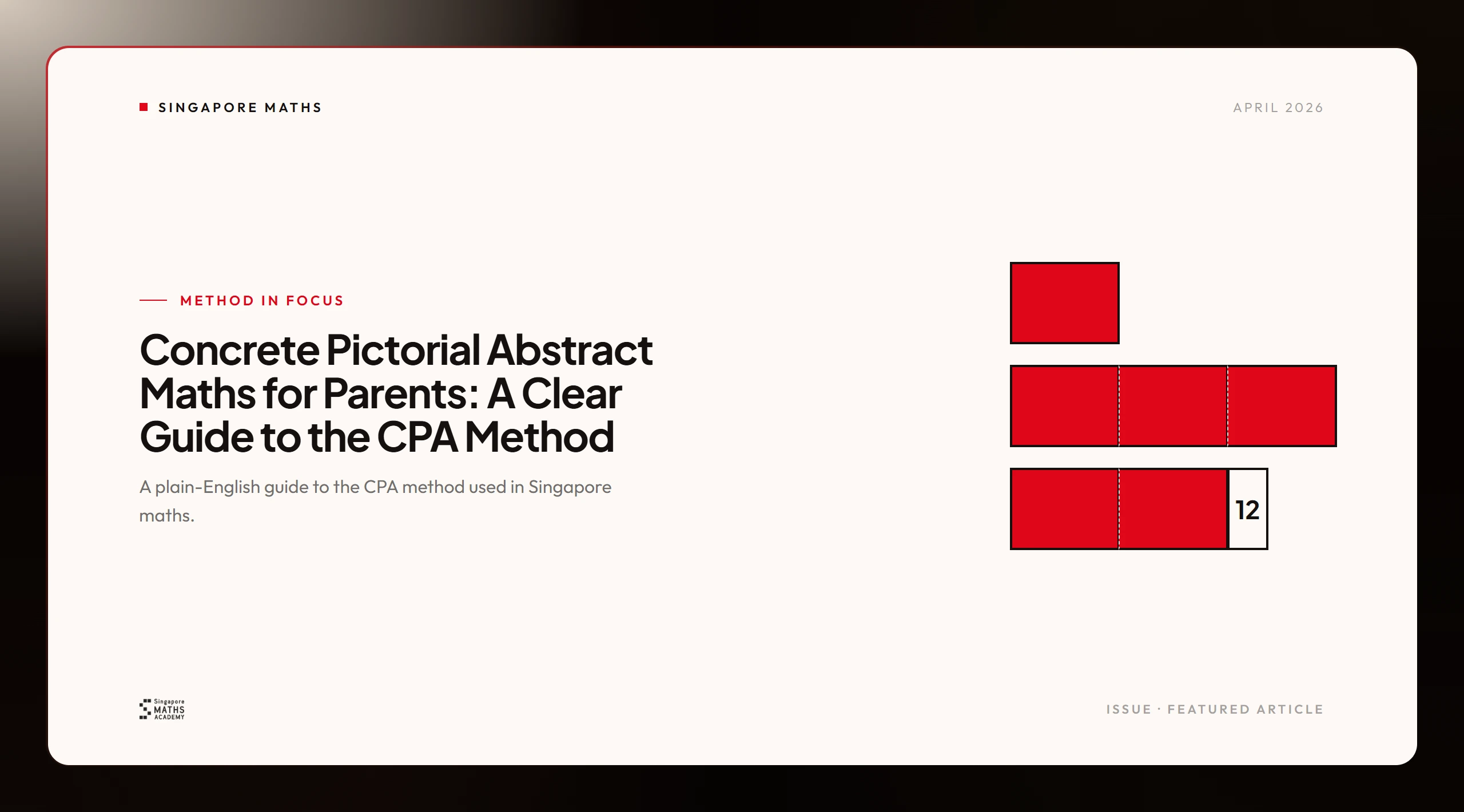
At the pictorial stage, children move from physical objects to drawings and diagrams that stand for those objects. This is where the famous Singapore “bar model” sits — a rectangular diagram that represents quantities and relationships. Children learn to draw bars, circles, number lines, and dots to represent what they previously held in their hands.
The pictorial stage is a bridge. Without it, the jump from “I have three cubes and two cubes” to “3 + 2 = 5” is much larger than it needs to be.
Stage 3: Abstract
Only once the concrete and pictorial stages feel secure do children move on to the purely abstract — the numerals, operations, and equations we adults usually think of as “doing maths”. The crucial point is that by the time they reach this stage, the symbols mean something. They are no longer arbitrary marks to be manipulated according to a remembered rule; they are shorthand for ideas the child has already handled and drawn.
Why the CPA method works so well
It matches how children actually think
Young children learn through their senses first, then through images, and finally through language and abstraction. CPA follows that natural sequence rather than fighting it.
It builds genuine understanding, not memorisation
Children who learn this way tend to understand why a method works, which means they can recover it if they forget and apply it flexibly to new problems. Children who memorise procedures without understanding often struggle the moment a question is phrased unexpectedly.
It scales through school — with the right adjustments
CPA is often associated with primary, but the principle applies throughout a child’s school career. At primary and 11+, CPA is central — heavy use of bar models, hands-on resources, and visual reasoning. At KS3, we gradually transition students to more abstract methods as their foundations mature. By GCSE and A-level, students work primarily with abstract methods, with CPA available as a grounding tool when new topics need it. This is how it should work: CPA builds foundations; once mastered, the move to abstract is progress, not a departure.
How to support CPA at home
Slow down with objects
When helping with homework, do not rush your child to write numbers. If they are stuck on a word problem, pull out counters, buttons, or even sweets and work it out physically first.
Encourage drawing
If a problem is tricky, ask your child to draw what is happening — even if it looks messy. Bar models, number lines, and simple diagrams are maths, not a distraction from it.
Let the symbols come last
Resist the urge to jump to “so what is 6 + 7?” before your child has made sense of what the question actually means. The symbols are the shorthand, not the starting point.
See CPA in action
At Singapore Maths Academy, our primary and 11+ lessons are built firmly on the concrete-pictorial-abstract approach — bar models, visual reasoning, and careful problem-solving before formal procedures. Our founder was personally trained in Singapore by Dr Yeap Ban Har, the world’s leading Singapore Maths expert, and went on to train teachers across the UK and internationally. CPA is not a method we have adopted; it is what we are built on.
Contact us today and see for yourself what concrete pictorial abstract maths looks like when it is taught properly — and why parents across the UK and internationally choose it for their children.
