
Ratio is one of those topics that trips up children at every stage — from Year 5 word problems right through to GCSE. It looks deceptively simple on the surface, but the moment a question adds context or asks for comparison rather than sharing, many children reach for a procedure they half-remember and lose their way. The bar model for ratio Singapore maths approach offers something more reliable: a visual method that makes the structure of any ratio problem immediately visible and the arithmetic naturally accessible.
Why Ratio Causes Difficulty — and What Bar Models Fix
The root of the difficulty with ratio is that it is a multiplicative relationship, not an additive one. Children who have spent most of primary school working with addition and subtraction can find it hard to shift their thinking. When they read “the ratio of blue marbles to red marbles is 3:2”, their instinct is often to subtract or add rather than to think in equal parts.
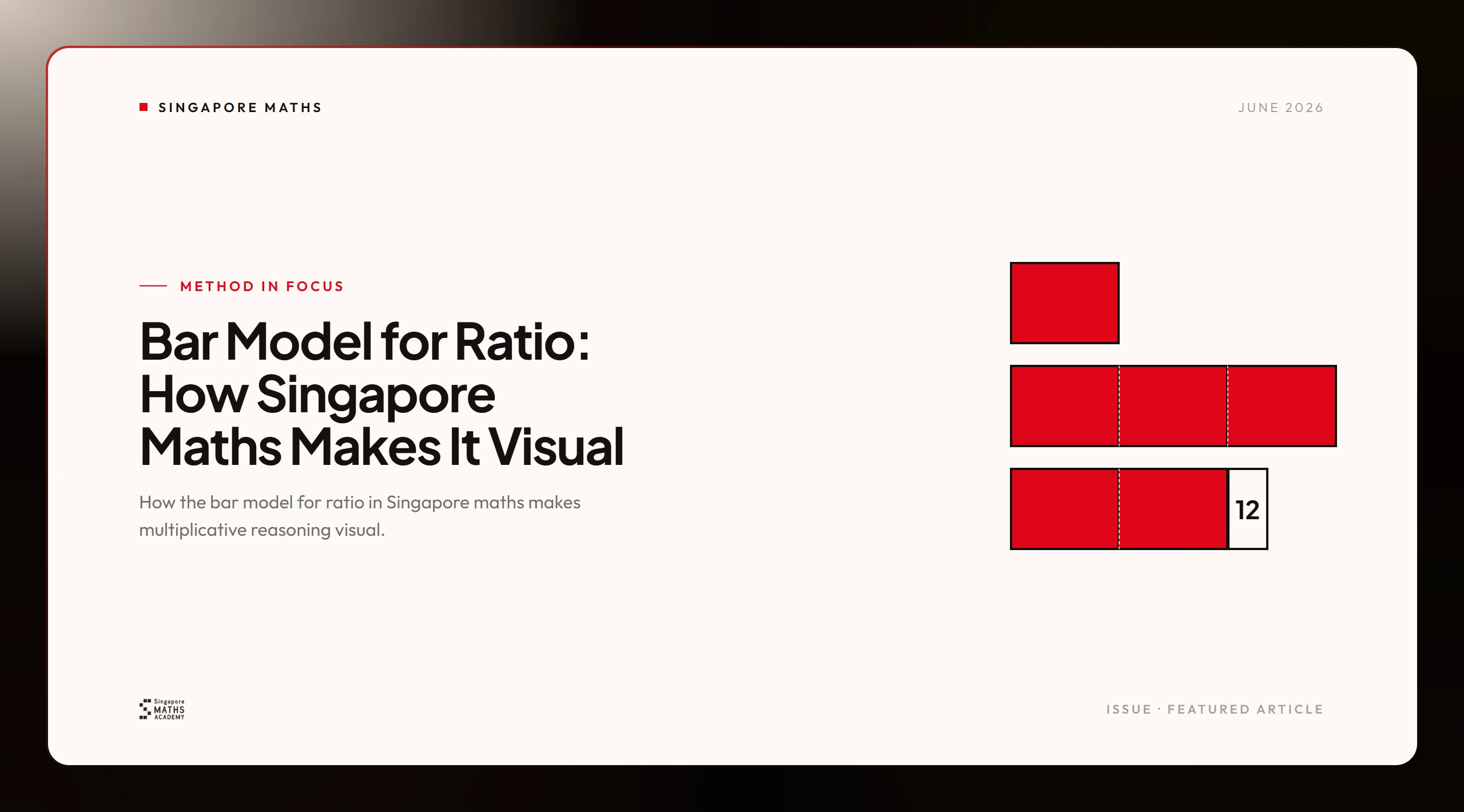
The bar model resolves this by making the multiplicative structure visible. Instead of working abstractly with the numbers 3 and 2, a child draws three equal bars for blue and two equal bars for red — and immediately sees that the whole is five equal parts. The relationship between the groups, and between each group and the total, becomes a picture rather than an abstraction.
Singapore Maths has placed the bar model at the centre of its approach to ratio and proportion since the 1980s, which is a large part of why Singapore has consistently ranked at or near the top of international maths assessments such as TIMSS and PISA. The method does not ask children to be clever — it asks them to be systematic, which is a far more teachable quality.
How the Bar Model Works for Ratio Problems
Sharing in a Given Ratio
The most common early encounter with the bar model for ratio is a sharing problem: “Share £40 in the ratio 3:1.” A child draws three bars for one quantity and one bar for the other. Four equal bars totalling £40 — each bar is £10, so the shares are £30 and £10. The model makes clear why each step follows from the previous one, and children do not need to memorise a formula.
Finding a Quantity Given the Ratio and One Amount
Slightly more challenging is the reverse problem: “Tom and Sara share some money in the ratio 5:3. Tom receives £35. How much does Sara receive?” Here the child draws five bars for Tom and three for Sara. If five bars equal £35, each bar is £7, so Sara’s three bars equal £21. The bar model makes the logic transparent — children are reasoning from the picture, not executing a memorised algorithm.
Ratio, Total, and Finding the Whole
A more challenging variant gives only the total and asks students to find individual shares — or gives one share and asks for the total. Bar models handle both with the same structure: draw the ratio, assign the known value to the appropriate number of bars, and find the value of one bar. From there, any other quantity in the problem can be read off directly.
Ratio and Algebra at KS3
As children move into secondary school, ratio problems become more sophisticated — involving percentages, rates, or algebraic expressions. The bar model serves as a bridge here too, allowing students to set up the structure visually before transitioning to algebraic methods. A student who has spent two years working with bar models for ratio at primary level arrives at KS3 with a strong intuition for multiplicative reasoning that accelerates their algebra work considerably.
The Concrete–Pictorial–Abstract Progression
The bar model is the pictorial stage of the Concrete–Pictorial–Abstract (CPA) approach that underpins Singapore Maths. At the concrete stage, children might use counters or blocks to physically represent a ratio. The bar model — a drawing — is the pictorial stage. Only when this representation is secure do we introduce the abstract notation that most adults associate with ratio work.
This progression is not about keeping children on simpler material for longer — it is about building genuine understanding at each stage before moving to the next. A child who rushes to the abstract without the pictorial foundation will find ratio work increasingly difficult as it grows more complex. A child who has worked through the CPA progression carefully will find that more complex ratio problems are simply more elaborate versions of something they already understand well.
Our founder was personally trained by Dr Yeap Ban Har — the world’s leading Singapore Maths expert — and went on to train teachers in bar model and CPA pedagogy through Bar Model Company. This depth of expertise in the methodology is what our tutors bring to every lesson.
Ratio in the 11+ and Beyond
For children preparing for the 11+, ratio word problems are a reliable feature of every major paper format. Questions often present ratio alongside other topics — fractions, percentages, or algebra — which is precisely the kind of multi-step problem that rewards a structured visual approach over a remembered procedure.
At Singapore Maths Academy, our 11+ pupils work with bar models for ratio throughout Year 4 and Year 5, building fluency that pays dividends when they encounter these problems under timed conditions. You can see worked examples and ratio problem walkthroughs on our YouTube channel.
For children at KS3 working towards GCSE, ratio remains a high-frequency topic across all exam boards. Our secondary maths tuition continues to use visual representations where they support understanding, while transitioning students towards fully abstract methods as their foundations become secure.
A Method Built for How Children Actually Learn
The bar model for ratio works because it aligns with how the brain actually develops mathematical understanding — from the concrete and visual towards the abstract. It does not demand that children think in a way that is developmentally premature. It meets them where they are and builds from there.
You can read more about how bar models are used across different topics in our post on the bar model method. If you would like to discuss how our approach could support your child’s ratio work — whether for 11+ preparation, KS3, or GCSE — contact our team and we will be happy to talk through the options.
