
Why Fractions Are the Ideal Starting Point for Bar Modelling
Of all the topics in Year 5 maths, fractions present the most consistent challenge. Children who are otherwise confident with number can find fraction problems genuinely difficult — not because the arithmetic is complicated, but because the concept of a fraction as a relationship between parts and a whole is more abstract than it first appears.
Bar models for fractions in Year 5 provide a visual structure that makes this abstraction concrete. Instead of working from symbolic notation alone, children draw rectangular bars to represent the whole, divide them into equal parts, and reason about the relationships between those parts. This approach — central to the Singapore maths method — develops a depth of understanding that translates directly into accurate calculation and, later, into confident handling of fractions in ratio, proportion, and algebra.
What Year 5 Fractions Cover
The Year 5 national curriculum for fractions is substantial. Children are expected to work with fractions as operators, compare and order fractions with different denominators, add and subtract fractions including mixed numbers, multiply fractions by whole numbers, and link fractions to decimals and percentages. Each of these involves a different way of thinking about what a fraction is and what it represents.
Without a visual tool, children working across all these variations are essentially juggling abstract rules. With the bar model, each type of fraction problem has a visual structure that makes the relationships immediately clear.
How Bar Models Represent Fractions
The core principle is straightforward. A single rectangular bar represents the whole. The bar is divided into equal parts that correspond to the denominator, and a number of those parts — corresponding to the numerator — are shaded or labelled. From this simple starting point, a wide range of fraction problems become visually solvable.
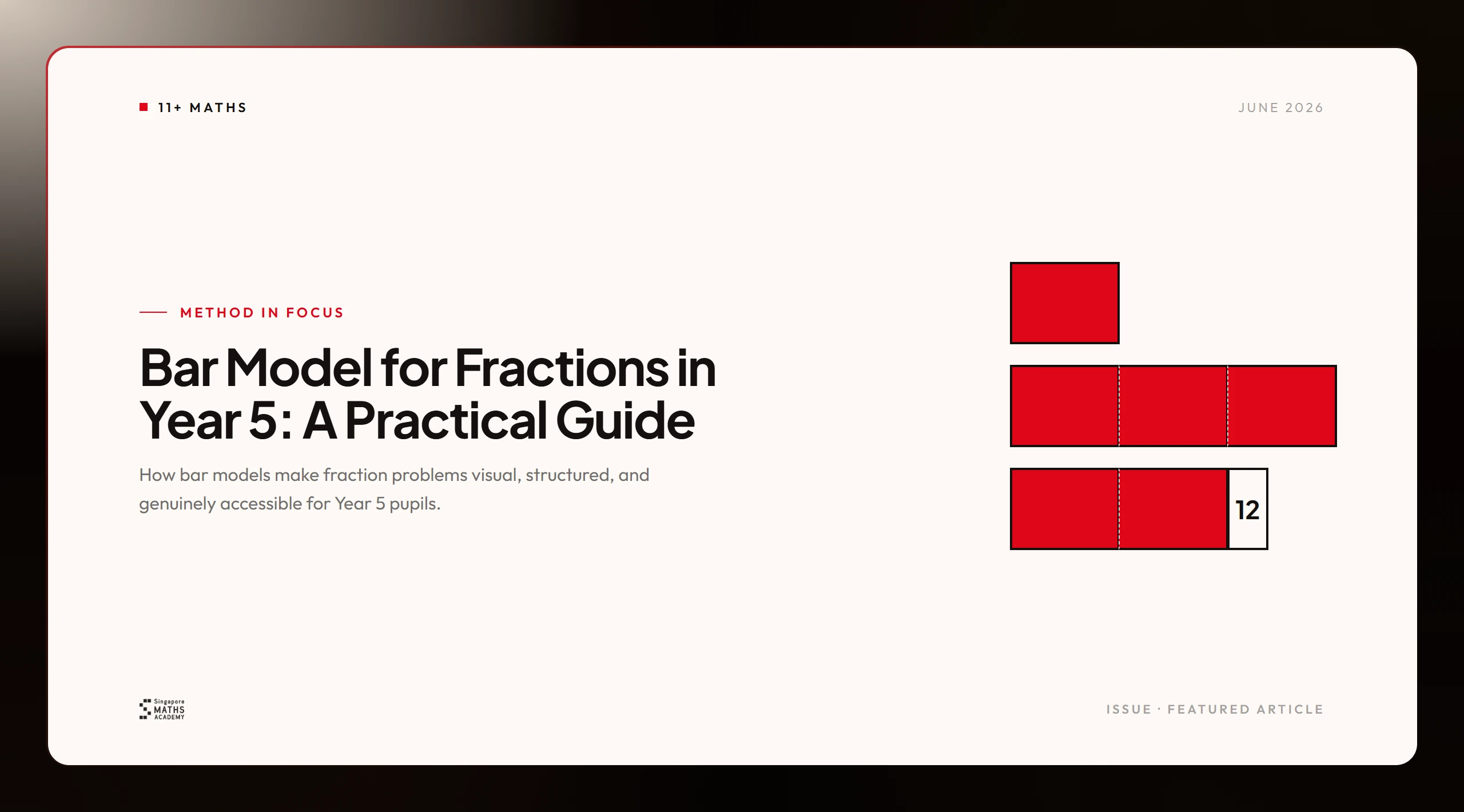
Consider a typical Year 5 problem: “Mia spent three-fifths of her money on books and had £12 left. How much did she start with?” Without a visual tool, most children find this difficult to approach. With a bar model, the solution is straightforward: draw a bar divided into five equal parts. Three parts are spent; two parts remain. Two parts equal £12, so one part is £6, and the whole bar — five parts — is £30.
The calculation involved is simple. The difficulty was in seeing the structure of the problem. The bar model makes that structure visible.
The CPA Approach and Why It Works
Bar modelling sits within the broader CPA — concrete, pictorial, abstract — progression that underpins Singapore maths, developed through the work of educators including Dr Yeap Ban Har. The sequence moves from physical manipulation of objects, through drawn representations such as bar models, to symbolic notation. Each stage supports the next.
For fractions in Year 5, this means children first encounter fraction concepts with physical objects — folding paper, sharing cubes, partitioning shapes. They then move to drawn bar models, which allow them to represent more complex relationships than physical objects easily permit. Finally, they apply symbolic notation — the fraction rules and algorithms — with the understanding that those symbols are representing something concrete they have already reasoned through.
Research consistently shows that children who use visual representations in maths develop stronger problem-solving skills. The bar model for fractions is the most direct application of this evidence in Year 5 work. The Bar Model Company has published extensive resources on this methodology for both teachers and parents, including worked examples and guides to the progression across year groups.
Adding and Subtracting Fractions with Bar Models
Adding fractions with different denominators is one of the areas where children most commonly make errors — typically because they add numerators and denominators separately without finding a common denominator. A bar model makes clear why this is wrong and what the correct process looks like.
To add one-half and one-third, draw two bars of the same length. Divide the first into two equal parts, the second into three. To compare the parts directly, both bars need to be divided into the same number of equal sections — six, in this case. The first bar shows three-sixths; the second shows two-sixths. Adding gives five-sixths. The visual representation makes the need for a common denominator obvious rather than arbitrary.
For mixed numbers — problems such as 2 and three-quarters plus 1 and two-thirds — the same principle extends. Two separate bar structures represent the two quantities, and the process of adding the whole number parts and the fractional parts separately, before recombining, is explicit in the drawing before it appears in the calculation.
Multiplying Fractions by Whole Numbers
This is a topic that children often learn as a rule — multiply the numerator, keep the denominator — without understanding why. Bar models make the underlying meaning clear.
Three times two-fifths means three groups of two-fifths. Draw three identical bars, each divided into five equal parts with two shaded. Count all the shaded parts: six-fifths, which simplifies to one and one-fifth. The rule is simply a shortcut for what the drawing shows. A child who understands this will not make errors of the form “three times two-fifths equals six-fifths… but I’m not sure if that’s right” — the visual confirmation is immediate.
Using Bar Models for Fraction Word Problems
Word problems involving fractions are a significant component of the 11 plus assessment, and bar models are the most reliable tool for approaching them. The general process is consistent: identify the whole, identify what fraction of the whole is known, represent it visually, and read off the answer from the structure of the diagram.
This process works equally well for questions involving two fractions operating simultaneously — for example, “Ethan spent a quarter of his pocket money on a book and a third on a game. He had £5 left. How much pocket money did he start with?” Finding a common denominator — twelfths — allows the two fractions to be represented together, the remainder identified, and the whole calculated. The bar model does not make the arithmetic easier, but it makes the structure of the problem clear enough that the right arithmetic presents itself.
You can watch our tutors work through problems like this on the Singapore Maths Academy YouTube channel, including Year 5 and 6 fraction problems of the kind that appear in 11 plus papers.
How Fractions Learned This Way Transfer to Later Topics
The depth of understanding developed through bar modelling in Year 5 pays dividends well beyond Year 5. Ratio and proportion in Year 6 and beyond are, structurally, extensions of the fraction thinking that bar models develop. Algebraic reasoning — solving for an unknown — follows the same logic as finding the size of one part in a bar diagram. Percentage problems, which can be taught as fraction problems with a denominator of 100, are immediately more accessible to children who already think in parts and wholes.
This is the preparation payoff that runs through Singapore maths at every level: skills built now transfer across topics. A child who genuinely understands fractions in Year 5 will not need to relearn the underlying concept when fractions appear in ratio, algebra, or proportion problems in Years 7 and 8. They will recognise the same structure in a new context.
How We Teach Fractions at Singapore Maths Academy
Our Year 5 sessions on fractions follow the CPA progression, with bar modelling as the central tool. Children are not asked to memorise rules before they understand the underlying relationships. Every procedure — finding common denominators, converting between fractions and decimals, working with mixed numbers — is introduced visually before it is formalised symbolically.
Our tutors are qualified teachers trained in the Singapore mastery method, working with small groups of around four to five children. This structure allows close attention to each child’s reasoning, ensuring that gaps are identified and addressed rather than papered over with procedural shortcuts.
Our 11+ maths programme includes dedicated work on fraction problem solving, including the bar model techniques described in this post. You can read more about our approach to bar modelling in our introductory post on the bar model method in maths.
To discuss your child’s current position with fractions and find out whether our sessions would be a good fit, get in touch with our team. We are happy to talk through what your child is working on and how we can help.
