
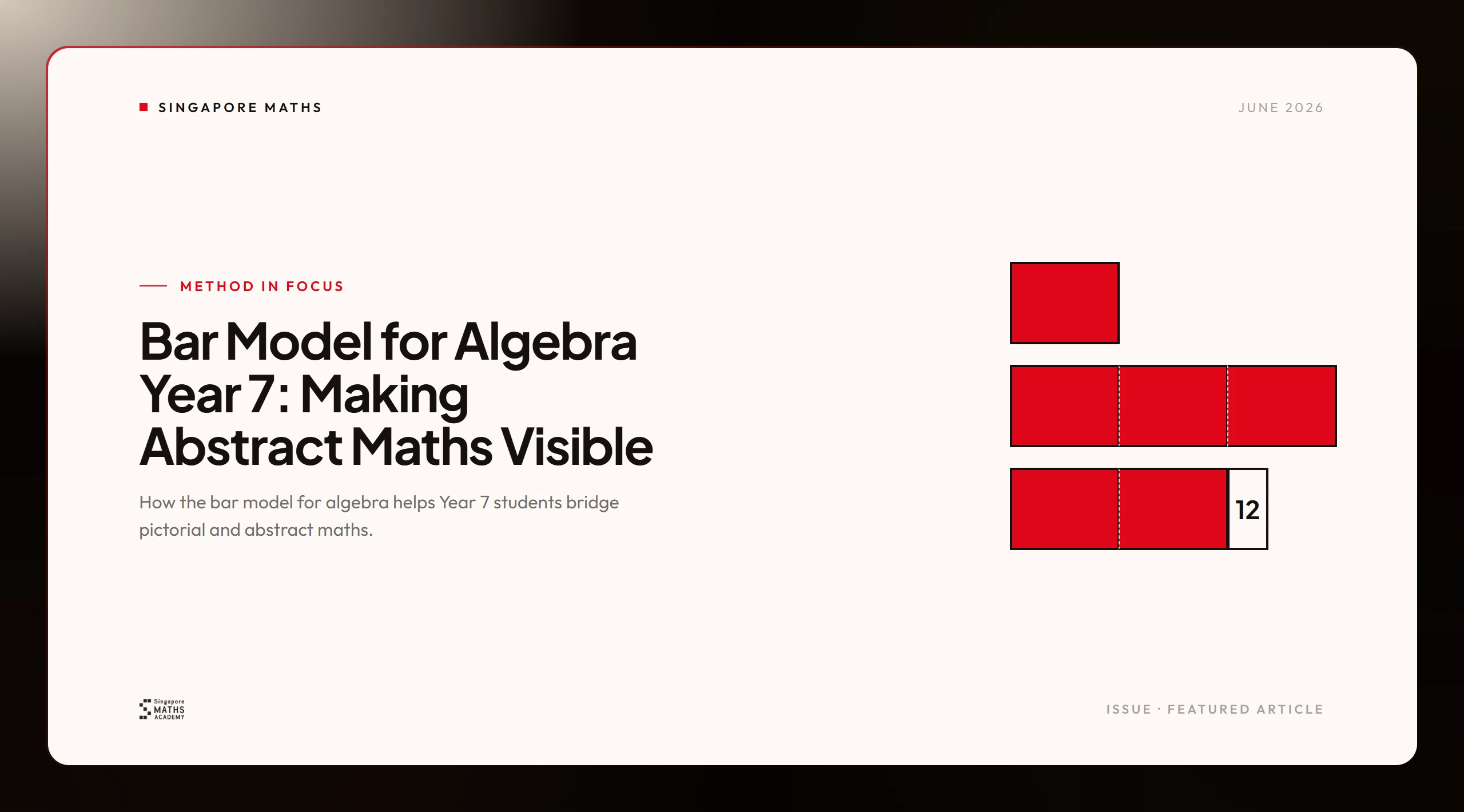
Many Year 7 students arrive at algebra with a sense that something has fundamentally changed in maths. Numbers have been replaced by letters, and the comfortable certainty of arithmetic has given way to something that feels abstract and unanchored. The bar model for algebra in Year 7 is one of the most effective tools for bridging that gap — giving students a visual framework that makes algebraic thinking tangible before the full abstract notation takes hold.
Why Algebra Feels Different in Year 7
The transition from primary maths to secondary maths is, in many ways, the transition from arithmetic to algebra. In primary school, most problems involve known quantities: you are working with numbers, and the answer is a number. In Year 7, students encounter unknowns for the first time in a formal sense — they are asked to find a value that has not yet been stated, and to use reasoning rather than calculation to find it.
For students who have been taught through the Singapore maths approach at primary level, this transition is considerably smoother. The bar model, which they will have used to represent word problems involving fractions, ratios, and proportional reasoning, translates directly into algebraic thinking. The unknown quantity — the letter in an equation — is simply an unnamed bar, a part of the total that has not yet been labelled.
What the Bar Model for Algebra Looks Like in Practice
Consider a straightforward Year 7 algebraic problem: a bag of apples and a bag of oranges together cost £14.50. The apples cost £3.50 more than the oranges. How much does each bag cost?
A student working without visual support might attempt to set up simultaneous equations from the outset — a technique that Year 7 students have typically not yet been taught formally, and which requires a fluency with symbolic manipulation that takes time to develop. A student using the bar model draws two bars of unknown length — one for apples, one for oranges — and marks the £3.50 difference visually. They can see immediately that removing the extra portion leaves two equal bars summing to £11.00, making each bar £5.50, and the apple bag £9.00.
The bar model has not bypassed algebra. It has made the algebraic structure visible. When this student later encounters the symbolic form of the same problem — a = o + 3.50, a + o = 14.50 — they will recognise it as a formal statement of something they already understand intuitively. That recognition is the foundation of algebraic fluency.
Bar Models and Algebraic Expressions
The bar model for algebra in Year 7 extends naturally to the manipulation of expressions, not just the solving of equations. When students need to understand why 3(x + 4) and 3x + 12 are equivalent, a bar model showing three equal sections each containing an unknown part and a 4-unit part makes the distributive law visible. The procedure of expanding brackets is no longer an arbitrary rule — it describes something that can be seen.
This visual grounding is particularly valuable for students who find abstract notation difficult to hold in working memory. Research consistently shows that children who use visual representations in maths develop stronger problem-solving skills. At Year 7, where the conceptual demands are increasing sharply, this scaffolding allows students to engage with genuinely more challenging material without becoming overwhelmed by notation.
At Singapore Maths Academy, our approach to secondary maths tuition incorporates bar models and other pictorial tools throughout Key Stage 3, tapering gradually towards fully abstract methods as students build confidence and fluency. This is consistent with the CPA (Concrete–Pictorial–Abstract) framework that underpins Singapore maths methodology — a framework explained in more detail on the Bar Model Company website, where our founder’s teacher-training work in CPA pedagogy is documented.
Common Year 7 Algebra Topics Where Bar Models Help
The bar model is not a universal tool — it is most effective in specific contexts. In Year 7, these include:
- Forming and solving linear equations — representing the unknown visually before translating to symbolic form
- Ratio and proportion — bar models were already used for this at primary level, and the continuity is significant
- Simple expressions and substitution — using bars to show what an expression represents before numerical values are substituted
- Word problems with unknowns — translating verbal descriptions into diagrams before writing equations
For ratio in particular, the bar model for algebra in Year 7 provides a natural bridge from primary-level ratio work (where ratios were expressed as concrete quantities) to secondary-level work (where ratios appear in algebraic contexts, alongside equations and graphs). Our post on the bar model method in maths covers this bridge in greater depth.
The Role of the Tutor in Year 7 Algebra
In a school classroom, a Year 7 maths teacher is managing a class of thirty students with varied prior knowledge and very different relationships with the bar model. Some students will have used it extensively at primary school; others will have encountered it rarely or not at all. A specialist tutor working in a small group of around four to five students (max eight) can assess each child’s visual-to-abstract readiness individually and pitch the use of bar models accordingly — deploying them as scaffolding where they are needed, and withdrawing them when a student is ready to work abstractly.
This calibrated approach is one of the reasons that working with a tutor who specialises in KS3 maths makes a significant difference at Year 7. The transition from pictorial to abstract is not a cliff edge — it is a gradual handover, and managing it well requires knowing each student well enough to judge when they are ready for the next step.
You can see this kind of reasoning in action on the Singapore Maths Academy YouTube channel, where worked examples show how bar models and algebraic notation are used together at the KS3 level.
Beginning Year 7 Algebra Tuition
If your child is finding the move into algebraic thinking more challenging than expected, or if you want to ensure they build genuinely secure foundations in Year 7 that will support them through GCSE and beyond, specialist secondary maths tuition can make a transformative difference. The goal is not just to get through Year 7 — it is to arrive at Year 9 and Year 10 with the fluency and confidence that allows ambitious targets to remain in reach.
Singapore Maths Academy has been supporting Year 7 students through this transition since 2014. Our qualified teachers understand both the Singapore maths methodology and the demands of the UK secondary curriculum, and our small-group online tuition gives each student the attention they need at exactly the moment they need it.
To find out more about our Year 7 and KS3 provision, contact our team and we will be happy to talk through the right option for your child.
