
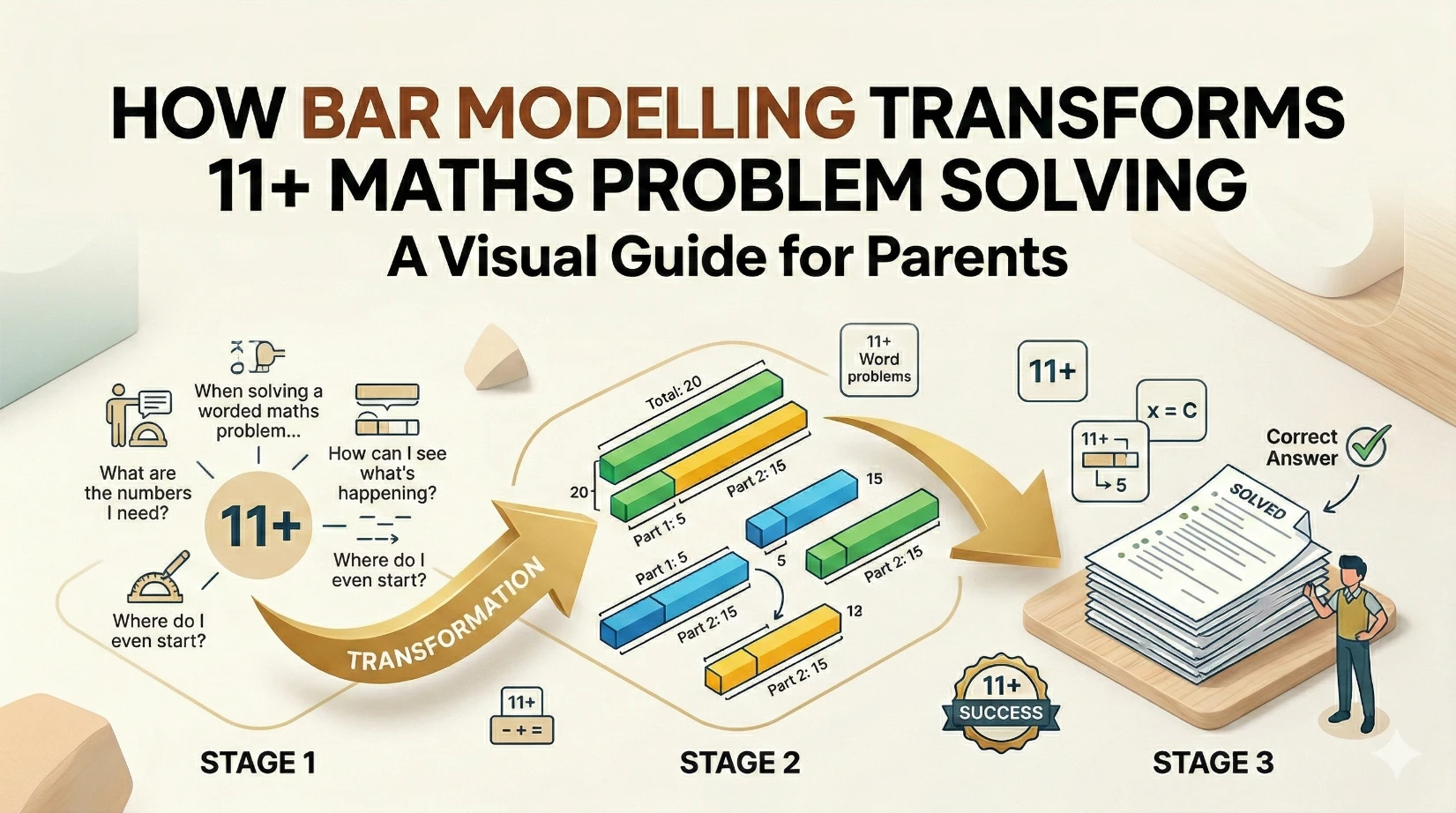
How Bar Modelling Transforms 11+ Maths Problem Solving
Bar modelling is one of the most powerful tools in the Singapore Maths method — and one of the most underused in traditional UK maths teaching. For 11+ students, it provides a systematic, visual approach to multi-step word problems that dramatically reduces errors and builds genuine understanding. This article explains what bar modelling is, how it works, and why it gives 11+ students a measurable advantage.
What is Bar Modelling?
A bar model is a visual representation of a mathematical problem using rectangular bars drawn to scale. Each bar represents a quantity or a relationship between quantities. Rather than jumping straight from a worded problem to an equation, students first draw the relationships — making the structure of the problem visible before any calculation begins.
There are three main types of bar model used in 11+ preparation:
- Part-whole model — used when a total is divided into parts. Ideal for fraction and proportion problems.
- Comparison model — used when two or more quantities need to be compared. Ideal for difference problems and questions involving “more than / fewer than” language.
- Ratio/sharing model — used when a quantity is shared in a given ratio. This is one of the most common 11+ problem types.
Bar Modelling in Action: Three 11+ Examples
Example 1: Ratio Problem
Problem: Tom and Sarah share 180 stickers in the ratio 3:2. How many stickers does Tom get?
Using a bar model, the student draws 5 equal boxes (3 for Tom, 2 for Sarah). The total of 180 stickers fills all 5 boxes, so each box = 36. Tom has 3 boxes = 108 stickers. The bar model makes the division into equal units completely transparent — there is no guessing which number to divide by.
Example 2: Comparison (Difference) Problem
Problem: A school has 240 more students than a local club. Together they have 560 members. How many students does the school have?
Drawing two bars — one for the club, one for the school — with the school bar extending 240 units beyond the club bar makes the relationship immediately clear. The student can see that two equal “club-sized” bars plus 240 = 560, so each club bar = 160, and the school = 400. Without the bar model, many students attempt this problem by trial and error, wasting valuable time.
Example 3: Fractions of a Whole
Problem: A baker uses 3/8 of his flour for bread and 1/4 for cakes. He has 12 kg left. How much flour did he start with?
A bar model divided into 8 equal parts makes the 3/8 and 2/8 (equivalent to 1/4) immediately visible. The remaining 3/8 corresponds to 12 kg, so each eighth = 4 kg, and the total = 32 kg. Many students without bar modelling attempt to manipulate fractions algebraically and make errors. The bar model makes the answer almost self-evident.
Why Singapore Consistently Tops PISA/TIMSS Rankings
Singapore has ranked at or near the top of the PISA (Programme for International Student Assessment) and TIMSS (Trends in International Mathematics and Science Study) international rankings for mathematics for several decades. A significant part of this success is attributed to the bar modelling method introduced as part of Singapore’s national mathematics curriculum in the 1980s. By teaching students to visualise mathematical relationships before calculating, Singapore’s approach builds the kind of flexible, transferable problem-solving skill that standardised tests reward.
The Moment Bar Modelling “Clicks”
In our teaching sessions, we consistently see a specific moment with 11+ students when bar modelling clicks into place. A student who has been attempting ratio and proportion questions using trial and error or by writing equations they don’t fully understand will suddenly — after working through a few bar models — start drawing the diagram before they’ve even finished reading the question. The confidence shift is immediate and visible. Once a student internalises the bar model as a default first step, they become significantly faster and more accurate on the problem-solving questions that carry the most marks in 11+ papers.
To find out how we use bar modelling and the full Singapore Maths approach in our 11+ tuition programme, get in touch — we’d be happy to discuss your child’s needs.